
What is a Comprehensive Plan?
A Comprehensive Plan is…
Required by the WA Growth Management Act (GMA), the Comprehensive Plan establishes a City’s 20-year vision. It outlines how future growth will be accommodated, based on various elements of the plan. It comprises a series of goals, objectives, policies, and actions for the future of communities. These will guide the day-to-day decisions of elected officials and local government staff.
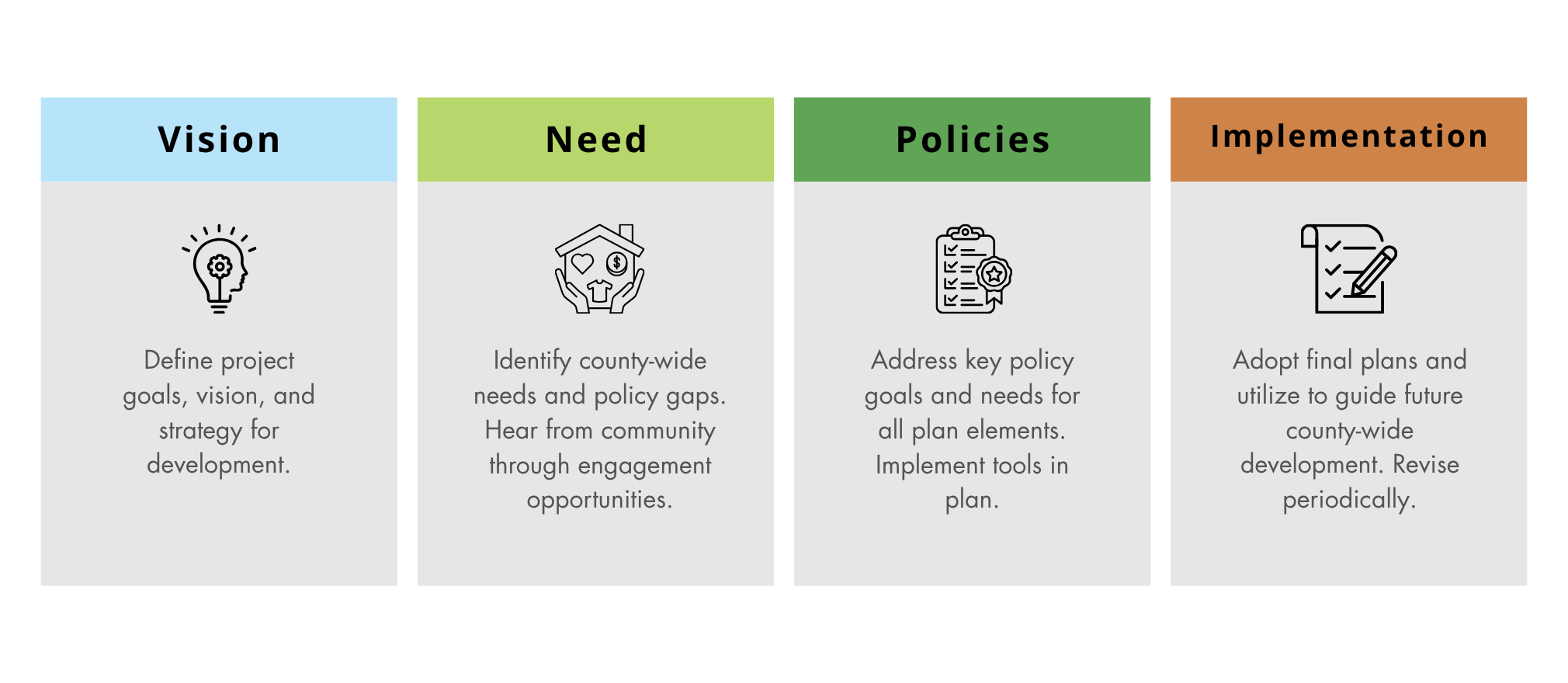
Plan Process
Plan Elements
1. Land Use
Establishes the framework for how land within a community will be used and developed over time, guiding zoning, growth patterns, and the balance between residential, commercial, industrial, and open space areas.
2. Housing
Identifies current and future housing needs and outlines strategies, policies, and actions to ensure the availability of affordable and diverse housing options for all income levels.
3. Transportation
Outlines how the community will develop and maintain a balanced, efficient, and multimodal transportation system that supports land use patterns and meets the mobility needs of all users.
4. Utilities
Ensures that essential services such as water, sewer, power, and others are planned, coordinated, and provided in a way that supports existing and future development efficiently and sustainably.
5. Capital Facilities
Identifies and guides the siting of regional and local facilities that are necessary to serve the public, such as airports, solid waste sites, and others.
6. Climate Resiliency
Outlines how the county will prepare for, adapt to, and mitigate the impacts of climate change by coordinating policies and actions to strengthen environmental, social, and economic resilience.
7. Rural Element
Guides growth and development in rural areas to maintain rural character, protect natural resources, and ensure that rural lands support agriculture, recreation, and other traditional rural uses.
8. Economic Development
Outlines strategies to strengthen the county’s economy while ensuring that growth is consistent with rural and urban land uses.
9. Essential Public Facilities
Identifies the public facilities and infrastructure needed to support growth, and outlines how these investments will be financed, maintained, and timed to ensure adequate service levels for the community.
10. Natural Settings & Water Resources
Protects and manages the county’s natural systems to preserve environmental quality, ensure clean and sufficient water supplies, and support sustainable land use and development.
Who determines how much we grow?
Under the GMA, the state Office of Financial Management (OFM) develops population projections for the state and each county. Each "fully planning" county is then mandated to determine, in consultation with cities, where that growth should be directed to occur. Once these growth projections are adopted, then the county and cities are to use them in their comprehensive planning processes and make sure that their plans can accommodate the projected level of growth.
Growth Management Act - Chapter 36.70A RCW
Periodic updates are mandatory
Consistency and coordination is required
Public participation is essential
Community Vision is a crucial part
Under GMA, comprehensive plans are required to include goals, policies, and actions that guide local growth and development.
They carry out the elements of a comprehensive plan by turning the community’s vision and state requirements into clear guidance for local decision-making and operations.
Goals
Broad statements indicating a general aim or purpose to be achieved. A goal is a direction setter, an ideal future end, condition, or state related to the public health, safety, or general welfare toward which planning and implementation measures are directed.
Policies
An objective is a topic-specific statement providing guidelines for current and future decision-making. It indicates a clear commitment of the local legislative body. A policy is an extension of a plan’s goals, reflecting topical nuance as well as an assessment of conditions.
Actions
Actions are budgetable steps envisioned or undertaken to implement plan policies. Actions may include the development of more detailed and localized plans, work to implement policies, formal agreements, regulations or other strategies.